

By J. McKay Halverson, Associate, Atlanta
Customer concentration risk is a frequent occurrence for privately held companies, yet it often is overlooked within valuation analyses. This discussion presents a framework for isolating and estimating the effect of customer concentration risk within the company-specific risk premium ( “CSRP”). By linking modeled cash flow disruption scenarios to implied discount rate adjustments, valuation professionals can more directly support CSRP selections and improve the transparency and defensibility of their valuation opinions.
Introduction
Customer concentration is common for many private companies. Across industries, it is not uncommon for a small number of customers to account for a meaningful portion of a company’s total revenue. These relationships might create the majority of value for the subject company, having been developed over a long period of time, and often reflect operational stability or strategic alignment.
However, concentrated revenue can introduce risk. The loss, reduction, or renegotiation of a key customer relationship might affect short-term revenue, profitability, and long-term growth expectations. For valuation professionals, this raises a practical question: How should customer concentration risk be incorporated into a valuation analysis?
The CSRP is one of the primary mechanisms for incorporating risks that are not captured within broader equity risk components. However, the estimation of the CSRP remains highly dependent on professional judgment. Valuation professionals typically rely on a qualitative factor analysis, supplemented by reasonableness checks, to ascertain the CSRP. Although this approach is accepted practice, it might be challenging to isolate and support discrete risk factors, such as customer concentration, in a structured way.
Customer Concentration Risk
Customer concentration risk refers to the exposure of a company’s financial performance to a small number of revenue-generating relationships. When a company has a significant portion of revenue from one or several customers, its future performance becomes more sensitive to changes in those relationships.
This exposure might arise for several reasons, including:
- Long-standing contractual relationships with key customers
- Limited diversification within a specific end market
- Dependence on a small number of distribution channels
- Specialized products or services tailored to particular customers
From a valuation perspective, customer concentration risk has several implications when using the income approach for valuation.
First, cash flow becomes more susceptible to variability. A single adverse event, such as the nonrenewal of a contract, loss of a major account, or pricing pressure, might result in a steep change in revenue rather than a gradual change.
Second, forecasting becomes more uncertain. Even when company management expects a key relationship to continue, there might be limited visibility into renewal terms, customer demand, or competitive pressures.
Third, customer bargaining power might increase. A customer that represents a large portion of a company’s revenue might have more leverage in negotiating pricing, contract terms, or service levels.
These characteristics align with the concept of company- specific risk. In developing a required rate of return for an investment in a company, customer concentration risk is not diversified away at the company level and thus is not fully captured in systematic measures, such as beta, or investment risk premiums, such as size or industry risk.
As a result, customer concentration often is considered within an idiosyncratic risk premium known as the CSRP.1 However, it is not always clear how this consideration might translate into a specific premium.
Why Customer Concentration Risk Matters
Customer concentration risk matters because it affects the expected level and variability of future cash flow of a business.
In practice, valuation models often incorporate projections based on company management discussions that assume continuity. Revenue is projected to increase based on historical trends or management expectations. Margins are held constant or adjusted incrementally. Working capital and capital expenditures follow a stable trajectory.
These assumptions might implicitly assume that key customer relationships continue without disruption. However, an investor might evaluate the same company from a different perspective—one that considers the potential for disruption in concentrated revenue streams. This disruption would decrease the enterprise value.
Estimating Customer Concentration Risk
In practice, customer concentration risk may be incorporated into a valuation analysis through two general adjustments:
- An adjustment to the projected cash flow
- An adjustment to the present value discount rate (i.e., the required rate of return)
Each has its advantages and limitations. The selection between them, or the combination of both, depends on the facts and circumstances of the subject analysis.
Projected Cash Flow Adjustment
Under a cash flow adjustment, the valuation professional explicitly incorporates customer concentration risk into the revenue forecast.
This might involve:
- Modeling a probability-weighted loss of a key customer
- Incorporating scenario analyses that include varying churn2 assumptions
- Adjusting growth rates to reflect potential churn
- Estimating recovery periods after churn
A revenue forecast adjustment directly reflects the potential economic effect of customer concentration. It aligns the projected cash flow with the valuation professional’s expectations regarding customer retention and replacement. However, this adjustment introduces additional assumptions:
- Probability of customer loss
- Timing of potential churn
- Magnitude of revenue effect
- Ability to replace lost revenue
Each of these assumptions might be difficult to quantify and support with empirical data.
Discount Rate Adjustment
An alternate adjustment is to incorporate customer concentration risk into the CSRP.
Under this framework, the valuation professional assumes baseline cash flow projections that reflect ongoing operations without discrete customer loss. The risk associated with potential customer disruption then is captured through an incremental adjustment to the discount rate (i.e., the CSRP).
One way to estimate this adjustment is through a structured backsolve analysis.
Backsolve Framework
The following steps outline a practical backsolve analysis:
- Establish a baseline valuation
- Develop a discounted cash flow model assuming no customer churn
- Select a baseline CSRP that reflects other company-specific risks
- Model customer concentration scenarios
- Introduce discrete customer revenue loss (e.g., 10 percent, 25 percent, 40 percent)
- Measure the resulting effect on enterprise value
- Hold the value constant
- Revert to baseline cash flow projections that include no churn
- Adjust the discount rate until the valuation equals the churn scenario value
- Isolate the incremental premium
The difference between the adjusted CSRP and the baseline CSRP represents the implied customer concentration risk premium.
To illustrate the economic impact of this adjustment, consider a simplified valuation framework using the discounted cash flow method of the income approach in which all assumptions are held constant except for customer concentration.
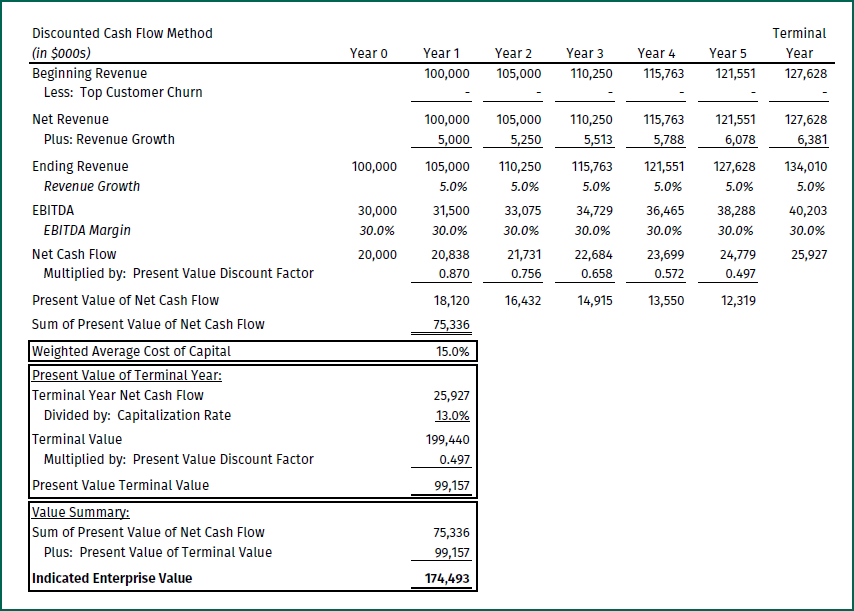
Table 1: Company Valuation – Baseline Scenario
EBITDA = Earnings before interest, taxes, depreciation, and amortization
In this example, a company is projected to generate $100.0 million in revenue during year 1 and have 5 percent annual growth. A baseline scenario assumes a stable customer base and no churn.
Under these assumptions, the subject company produces an indicated enterprise value of $174.5 million, as presented in Table 1 above.
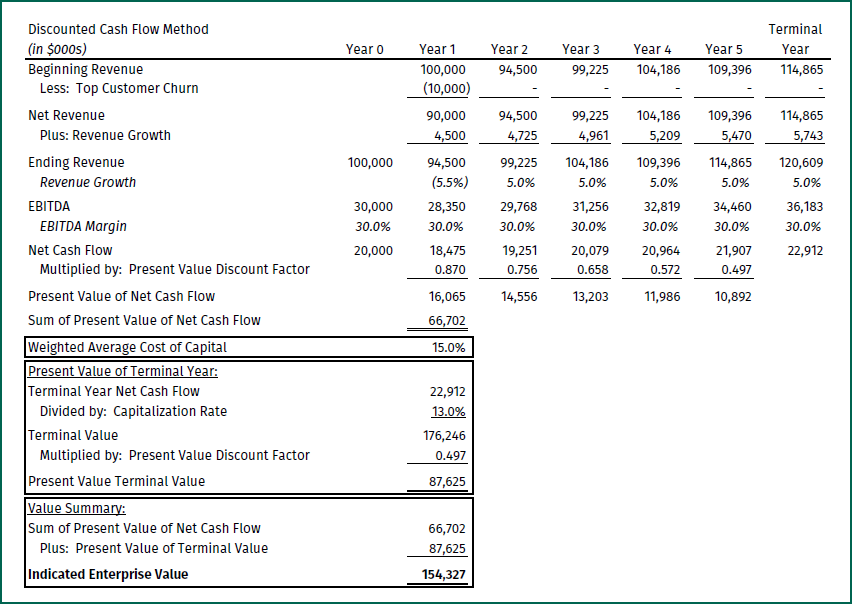
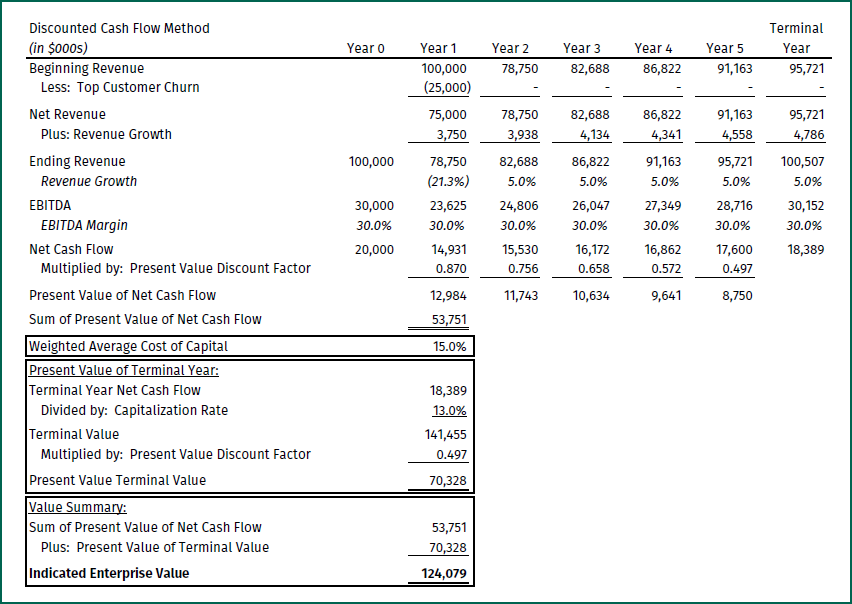
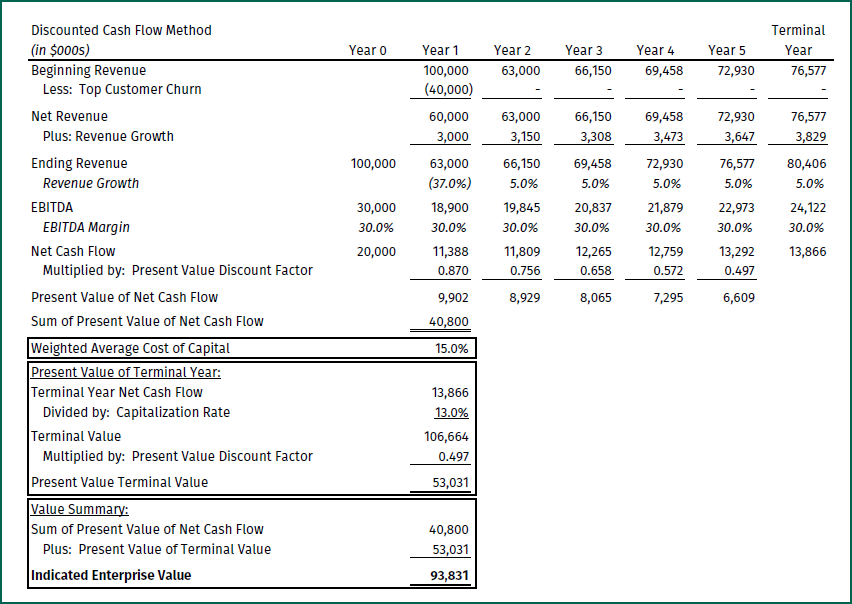
Introducing customer concentration through discrete churn scenarios results in materially different enterprise value indications. Now, the following assumptions were added to the example company valuation:
- Scenario 1 – 10 percent revenue concentration in a single departing customer
Table 2: Company Valuation – Scenario 1
EBITDA = Earnings before interest, taxes, depreciation, and amortization
- Scenario 2 – 25 percent revenue concentration in a single departing customer
Table 3: Company Valuation – Scenario 2
EBITDA = Earnings before interest, taxes, depreciation, and amortization
- Scenario 3 – 40 percent revenue concentration in a single departing customer
Table 4: Company Valuation – Scenario 3
EBITDA = Earnings before interest, taxes, depreciation, and amortization
As presented within each scenario, as the company’s top customer departs, the effect on enterprise value increases disproportionately as the projected year 1 revenue declines, all other factors and assumptions remaining the same.
Several observations may be drawn from this analysis.
Magnitude of Effect
The change in indicated enterprise value is material as the top customer’s percentage of revenue increases. Even at lower levels of concentration, the loss of a single customer representing 10 percent of a company’s revenue results in a noticeable disproportionate reduction in enterprise value (11.6 percent).
Nonlinear Effect
The decline in value is not proportional to the level of concentration. As the revenue concentration increases, the effect of the additional concentration becomes more pronounced. This reflects the compounding effect of risk on near-term cash flow and long-term expectations.
Risk Versus Event
It is important to distinguish between the event (customer loss) and the risk (probability and effect of such an event). The above scenarios illustrate the effect of a discrete event. However, investors generally price the probability of such events occurring, rather than assuming their certainty. This distinction is central to the treatment of customer concentration within a valuation.
If the valuation professional fully reflects a customer loss in projected cash flow, then the discount rate should not include a premium for that same risk. Conversely, if the projections assume stable continuity, then the discount rate may incorporate an incremental premium to the CSRP to reflect the risk of disruption.
Illustrative Results
Applying this adjustment results in the implied premiums presented in Table 5 below.
Table 5: Customer Churn Effect on Enterprise Value
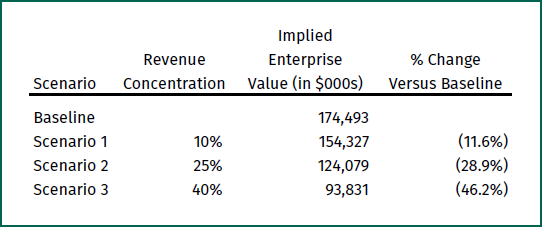
These results reflect the discount rate adjustment required to reconcile the economic effect of customer loss while maintaining baseline projections.
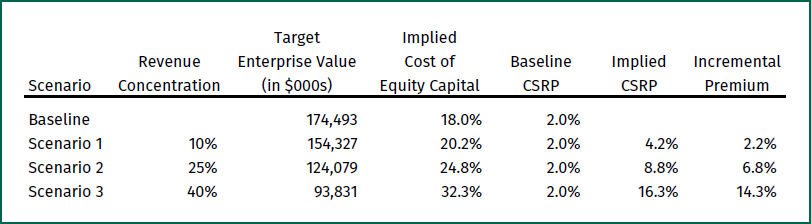
An additional step that may be considered is the probability of customer loss. For example, if there is a 50 percent probability in projected year 1 of the forecast period that a customer representing 10 percent of revenue will not renew, then the results in Table 6 below imply an incremental adjustment to the CSRP of about 1 percent (50 percent multiplied by 2.2 percent).
Table 6: Implied Incremental CSRP Adjustment
Interpretation
A backsolve framework does not suggest that a specific level of concentration corresponds with a fixed premium. Rather, it provides a mechanism for translating observed value effects into an implied rate of return adjustment.
The adjustment offers several practical benefits:
- It creates a direct link between economic outcomes and discount rate selection.
- It allows valuation professionals to isolate customer concentration from other CSRP factors.
- It provides a quantitative reference point to support professional judgment.
- It is transparent and reproducible.
- It can be helpful in discussion with clients, auditors, or other stakeholders.
Practical Considerations in Application
While the backsolve framework provides a structured starting point, the selection of a customer concentration risk premium ultimately may reflect the specific characteristics of the subject company analysis and the context in which the subject company operates. Not all instances of customer concentration present the same level of risk. For example, a company that has long-standing customer relationships, formal contracts, or meaningful switching costs might experience a lower degree of economic exposure than a company that has short-term or informal arrangements (i.e., the probability of loss might be lower). Similarly, the ability of the subject company to replace lost customers, diversify its revenue base, or access new markets might mitigate the practical effect of customer concentration over the forecast period.
Industry context also influences how customer concentration is viewed. In certain sectors, such as government contracting, original equipment manufacturing supply chains, or niche service providers, a concentrated customer base might be more common and, in some cases, expected. Regarding companies in these sectors, investors might assess customer concentration differently from sectors where diversification is more typical. As a result, the valuation professional should consider how comparable companies, transactions, or investors would evaluate similar levels of concentration when assessing the appropriate CSRP adjustment.
Customer concentration risk also interacts with other valuation inputs. If the valuation professional has incorporated customer-specific uncertainty into projected cash flow, such as through probability- weighted scenarios or more moderate growth assumptions, then applying an incremental premium in the discount rate for the same risk factor would result in double counting. Conversely, if the projections reflect continuity of customer relationships, then incorporating customer concentration risk within the CSRP might better align the discount rate with the underlying risk profile of the business. Accordingly, the treatment of customer concentration should be considered within the overall valuation framework to maintain consistency across assumptions.
In practice, the selected CSRP is informed by quantitative analysis and professional judgment. The backsolve procedure provides a reference point for understanding the magnitude of customer concentration risk; however, it does not eliminate the need for judgment regarding the probability, timing, and severity of potential customer disruption. Factors such as customer tenure, contractual protections, industry dynamics, and the company’s strategic positioning should inform the conclusion. If practical, a multivariate backsolve model may be most helpful in such cases.
Conclusion
Customer concentration risk is a measurable component of company-specific risk that can materially affect value. Although it is often discussed qualitatively, it also can be evaluated by applying a structured quantitative framework.
The methodology outlined in this discussion links modeled economic outcomes to implied discount rate adjustments. This connection provides a basis for supporting CSRP selections and enhances the transparency of the valuation process.
As valuation assignments continue to involve scrutiny from clients, auditors, and other stakeholders, analyses that clearly identify and support company-specific risks might provide additional insight and credibility. Customer concentration risk represents one such area where a structured framework can complement the valuation professional’s judgment.

About the Author

McKay is an Associate at Willamette Management Associates, based in our Atlanta office. He can be reached at (404) 475-2320 or at joshua.halverson@willamette.com.
References:
- A CSRP can include numerous risk factors, including customer co centration risk.
- Churn refers to the loss of a customer and the associated decrease in revenue.