

By Benjamin H. Maitski, Manager, Atlanta
Valuing an interest in a tiered business structure is not typically a straightforward appraisal assignment. As valuation professionals navigate multiple layers of control and marketability, the risk of double discounting becomes a potential issue. This discussion provides a quantitative framework to demonstrate the avoidance of double discounts.
Introduction
Multilevel valuation discounts arise when valuing companies that operate using layered ownership structures, particularly in the context of tax-related transfers.
Although the concept is straightforward in theory, its application can become complex in practice, particularly when multiple levels of minority ownership are involved.
Multilevel, or tiered, entity structures are common across corporations, partnerships, and limited liability companies. In this article, the terms “multilevel” and “tiered” describe structures in which an entity at the top (the “Parent Company” or “upper tier”) holds ownership interests in one or more underlying entities (the “Investment Companies” or “lower tier”). In many cases, the Parent Company itself is not an operating business but, rather, a holding company whose value is derived from its underlying investments.
Tiered structures exist for business, legal, and tax reasons. However, tiered structures introduce additional complexity for valuation professionals when estimating the value of an interest in the Parent Company, particularly when the subject interest is a noncontrolling interest at the upper tier.
When analyzing multilevel structures, the application of tiered valuation discounts is frequently scrutinized by the Internal Revenue Service because of the potential for duplicative, or double, discounts. In other words, there is a risk that the economic effects associated with lack of control or lack of marketability are reflected more than once across distinct levels of the tiered structure. Accordingly, when multilevel discounts are applied, such a scenario calls for clear articulation of the underlying rationale and support for the tiered discount selections.
Multilevel Entities
In a typical multilevel structure, the Parent Company holds varying ownership interests in one or more underlying Investment Companies. These interests may range from full control to minority, noncontrolling positions.
Figure 1: Parent Company #1 Organizational Chart
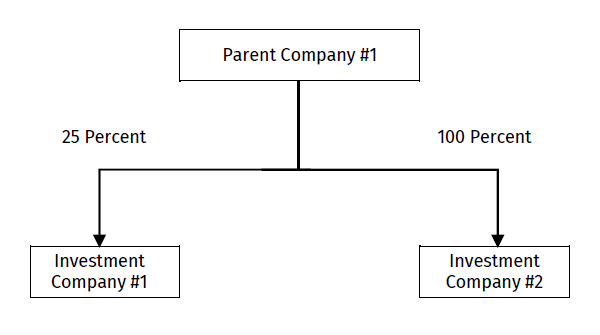
Consider the simplified structure illustrated in Figure 1 above. In this example, Parent Company #1 holds a minority, noncontrolling interest in Investment Company #1 and a controlling interest in Investment Company #2. This mix of ownership levels is common and is a key driver of valuation complexity in appraising an interest in Parent Company #1.
Multilevel discount considerations become particularly relevant when the subject interest is a minority interest in the Parent Company. In that situation, the valuation professional effectively values an indirect ownership position where the holder lacks control not only at the Parent Company level but also potentially at the Investment Companies level as well.
A clear understanding of the applicable standard of value and the level of value at each tier is important because these concepts directly inform whether and how valuation discounts should be applied.
Standard of Value and Level of Value
For many tax-related assignments, the applicable standard of value is fair market value. The Treasury Regulations to the Internal Revenue Code define fair market value as “the price at which such property would change hands between a willing buyer and willing seller, neither being under any compulsion to buy or to sell, and both having reasonable knowledge of relevant facts.”1
This definition of value frames the analysis in a hypothetical willing buyer and willing seller framework. The question is not what a specific investor might pay but, rather, how a reasonable and informed buyer and seller would evaluate the ownership interest.
Within this framework, the valuation professional typically evaluates each entity in the structure on a stand-alone basis, consistent with how a hypothetical buyer would assess the underlying investments. Those component values then are aggregated at the Parent Company level.
The valuation professional also may consider the entirety of the structure and how holding an assemblage of Investment Companies might enhance value from a purely stand-alone perspective. This might occur with conglomerates but is less likely in a typical family limited partnership structure.
An investor holding a noncontrolling (i.e., minority) interest lacks the ability to direct key decisions, including operating, financing, and investing decisions. This limitation typically reduces the attractiveness— and, therefore, the value—of the interest relative to a controlling interest. To adjust for these factors, the valuation professional may apply a discount for lack of control (“DLOC”).
Similarly, an investor in a nonmarketable interest faces liquidity constraints. Unlike publicly traded securities, such interests cannot be readily sold in an active market. Transactions often are negotiated privately, might require considerable time to complete, and involve uncertainty around pricing and execution. In many cases, a sale also might trigger legal, contractual, or practical restrictions. Because of these factors, investors typically require a discount to achieve a required rate of return, and the valuation professional may apply a discount for lack of marketability (“DLOM”).
Precedent Court Cases
While multilevel discounts are subject to heightened scrutiny by the Internal Revenue Service, several U.S. Tax Court and other federal court decisions provide guidance on when such discounts are appropriate.
Notable cases include (1) Astleford v. Commissioner, (2) Gallun v. Commissioner, (3) Gow v. Commissioner, (4) Martin v. Commissioner, and (5) Estate of O’Connell v. Commissioner. Collectively, these decisions illustrate how courts evaluate the use of multilevel discounts and the circumstances under which they may be accepted or rejected. In general, Astleford, Gallun, and Gow support the application of multilevel discounts, while Martin and O’Connell demonstrate situations where such discounts are disallowed.
In Astleford, the court considered a gift of a 30 percent interest in a partnership. The partnership held, among other assets, a 50 percent interest in a real estate general partnership. The court allowed discounts at the partnership (upper tier) and general partnership (lower tier) levels. This conclusion was supported, in part, by the illiquid nature of the underlying real estate and the fact that the general partnership represented a relatively small portion of the partnership’s total asset base. As a result, the court found that the economic characteristics of each tier warranted separate consideration, so multilevel discounts were not duplicative.2
In Gallun, the subject interest involved a noncontrolling position in a leather tanning company. In addition to its operating business, the company held an investment portfolio of stocks and bonds. The court concluded that discounts were appropriate at the operating company (upper tier) and the underlying investment portfolio (lower tier) levels. In reaching this conclusion, the court emphasized that the control and marketability characteristics of each component differed, so discounts at each level were not duplicative.3
Similarly, in Gow, the court allowed valuation discounts at the upper tier and lower tier. The parent company functioned as a holding company with an interest in a real estate joint venture. The court’s analysis focused on the distinct factors affecting control and marketability at each level, concluding that those factors were not duplicative and, therefore, supported separate discounts.4
In contrast, Martin disallowed the application of multilevel discounts. In that case, the court rejected significant discounts at the upper tier and lower tier, concluding that the discounts applied at the upper tier largely duplicated those already reflected at the lower tier. A key consideration was that the lower tier constituted approximately 75 percent of the upper tier’s total assets. However, the court allowed a smaller 5 percent discount at the upper tier, acknowledging that some incremental factors were present.5
A similar conclusion was reached in O’Connell, which involved a majority interest in a holding company that, in turn, held a controlling interest in an operating company. The court disallowed discounts at the upper tier, reasoning that the value of the holding company was driven by its ownership of the underlying operating company. Consistent with Martin, the court found that applying additional discounts at the upper tier effectively duplicated those already reflected at the lower tier. However, the court allowed a DLOM at the lower tier.6
While these rulings varied in outcome, the key takeaway is that the application of multilevel discounts is not uniform. Rather, it depends on the specific characteristics of the subject entities.
Accordingly, a clear understanding of those characteristics and explicit connections to the valuation conclusions through well-supported, fact-specific analysis is important to defend the application of such valuation discounts.
Avoiding Double Discounting
The common theme across the above cases is that double discounting is not appropriate when valuing a tiered entity structure. Consistent with this guidance, the valuation professional may adjust for factors affecting control and marketability without overstating the factors because of the presence of multiple ownership layers.
This procedure allows the valuation professional to explicitly consider discounts applied at the lower tier and incorporate that effect into the estimation of appropriate adjustments at the upper tier.
To perform this analysis, the valuation professional may:
- Evaluate whether incremental control or marketability risks exist at the upper tier
- Estimate the portion of net asset value already subject to discounts at the lower tier
- Select an appropriate DLOC or DLOM at the upper tier, reflecting incremental factors
- Calculate a weighted average discount, considering the relative contributions of discounted and non-discounted assets
This analysis demonstrates that lower-tier discounts have been explicitly considered and provides a structured basis for selecting upper-tier discounts. It also helps the valuation professional support a final appraisal conclusion that reflects the economic realities of the ownership structure without introducing duplicative adjustments.
The Weighted Average Discount
Now that the standard of value, level of value, and relevant court precedent have been outlined, the following example illustrates how these concepts are applied within a multilevel structure.
In this example, Parent Company #1 holds an investment in two Investment Companies. Investment Company #1 holds multiple real properties, and Investment Company #2 holds a portfolio of marketable securities. The assignment is to estimate the fair market value of a 5 percent interest (the “Subject Interest”) in Parent Company #1 for gift tax purposes.
Investment Company #1
The first step in such an analysis is to estimate the value of Investment Company #1, presented in Table 1 below.
Table 1: Investment Company #1 Valuation and Discounts
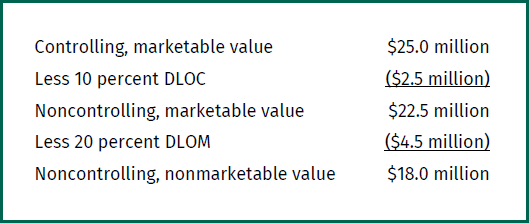
The valuation professional applies an asset-based approach and estimates that Investment Company #1 has an equity value of $100.0 million on a controlling, marketable basis. Parent Company #1’s 25 percent ownership interest, therefore, has an indicated value of $25.0 million on a controlling, marketable basis.
Because Parent Company #1 holds a minority interest in Investment Company #1, the valuation professional estimates an appropriate DLOC and DLOM at the Investment Companies level.
In assessing a DLOC, the valuation professional considers factors such as the rights and restrictions outlined in organizational documents, including the inability to unilaterally direct investment decisions, control distributions, or appoint management.
Based on this analysis and reference to empirical data, the valuation professional selects a 10 percent DLOC. After this discount is applied, the indicated value is $22.5 million on a noncontrolling, marketable basis.
The valuation professional then estimates a DLOM, considering the absence of an active market, transfer restrictions, and the time and uncertainty associated with a potential sale.
Based on these factors and supporting empirical evidence, a 20 percent DLOM is applied to the noncontrolling, marketable value of Investment Company #1. The resulting indicated value is $18.0 million on a noncontrolling, nonmarketable basis. The implied total discount for Investment Company #1 is 28.0 percent.
Investment Company #2
The next step in the analysis is to estimate the value of Investment Company #2.
As with Investment Company #1, the valuation professional applies an asset-based approach and estimates that Investment Company #2 has an equity value of $100.0 million on a controlling, marketable basis. Parent Company #1’s 100 percent ownership interest thus has an indicated value of $100.0 million.
Because Parent Company #1 holds a controlling interest in Investment Company #2, no DLOC is applicable. In addition, given the nature of the underlying assets and the characteristics regarding liquidity at this level, no DLOM is applied. Accordingly, the indicated value of Investment Company #2 remains $100.0 million on a controlling, marketable basis.
Parent Company #1
The final step in the analysis is to estimate the value of Parent Company #1, presented in Table 2 below.
Table 2: Parent Company #1 Indication of Value
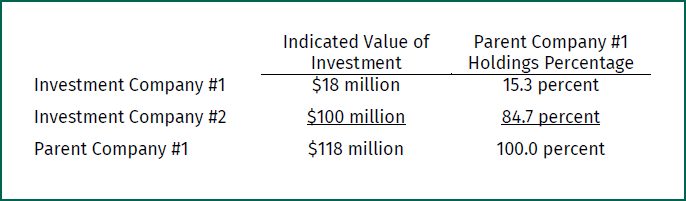
Parent Company #1 is a holding company whose value is derived entirely from its ownership interests in Investment Company #1 and Investment Company #2. The valuation professional applies an asset-based approach and aggregates the indicated values of the underlying investments.
Based on the prior analysis, the value of Investment Company #1 is $18.0 million, and the value of Investment Company #2 is $100.0 million. This results in a total indicated equity value of $118.0 million for Parent Company #1.
Because the Subject Interest represents a noncontrolling interest in Parent Company #1, the analyst considers the application of a separate DLOC and DLOM at the Parent Company level. At this stage, the analysis requires careful consideration of whether such discounts would reflect incremental economic attributes or merely duplicate those already captured at the lower tier.
The valuation professional first evaluates the composition of Parent Company #1’s net asset value. Investment Company #1—where discounts were applied— represents 15.3 percent of total net asset value, a relatively small portion of the total value. In contrast, Investment Company #2, which has not been discounted, constitutes 84.7 percent of the total.
Because a large portion of Parent Company #1’s value is derived from an asset that has not been adjusted for lack of control or lack of marketability, the application of a discount at the Parent Company level may be appropriate.
Weighted Average Discount Analysis
In evaluating a DLOC at the Parent Company level, the valuation professional considers the rights and restrictions applicable, including limitations on directing investment decisions, controlling distributions, and appointing or removing management.
The valuation professional also considers the extent to which these limitations have been reflected in the valuation of Investment Company #1. To the extent similar restrictions were incorporated at the lower tier, applying a full DLOC again at the upper tier could result in double discounting.
Table 3: Parent Company #1 Weighted Average DLOC
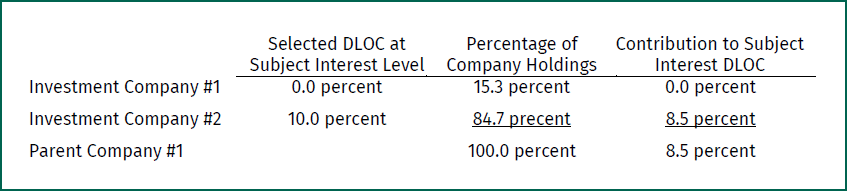
Absent any lower-tier discounts, the valuation professional might have selected a 10 percent DLOC at the Parent Company level. However, to account for the portion of value already subject to a DLOC, the valuation professional applies a weighted average discount analysis, presented in Table 3 above.
Because no incremental control limitations were identified for the portion of value attributable to Investment Company #1, a 0 percent DLOC is applied to that component. Notwithstanding this illustrative example, a valuation professional may identify that some incremental valuation discount applies. The full 10 percent DLOC is applied only to the portion of value not previously discounted. Based on this analysis, the valuation professional rounds and selects a 9 percent DLOC for Parent Company # 1 and the Subject Interest.
The valuation professional then evaluates a DLOM at the Parent Company level, considering the absence of an active market, transfer restrictions, and the time and uncertainty associated with a potential sale.
Although lack of marketability has been reflected in the valuation of Investment Company #1, the Subject Interest in Parent Company #1 is subject to additional structural and contractual limitations, which introduce incremental marketability constraints.
Table 4: Parent Company #1 Weighted Average DLOM
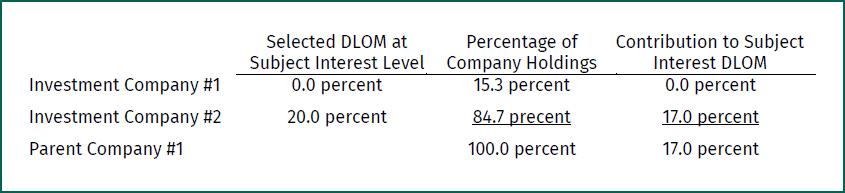
Absent prior discounts at the lower tier, the valuation professional might have selected a 20 percent DLOM at the Parent Company level. As with the DLOC analysis,a weighted average approach is applied, presented in Table 4 above. Based on this analysis, the valuation professional rounds and selects a 17 percent DLOM for Parent Company #1 and the Subject Interest.
After these discounts are applied, the indicated value of the Subject Interest in Parent Company #1 on a noncontrolling, nonmarketable basis is $4.5 million, as presented in Table 5 below.
Table 5: Subject Interest in Parent Company #1 – Valuation and Discounts
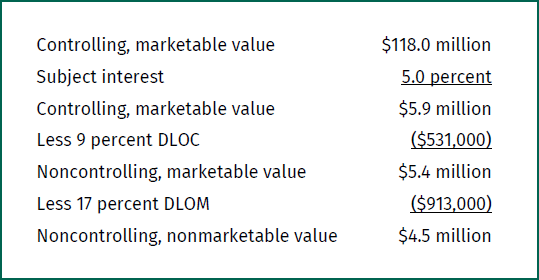
This conclusion reflects an implied aggregate discount of 28.7 percent from the non-discounted net asset value of Parent Company #1.
Summary
Multilevel discounts are not inherently appropriate or inappropriate. Rather, their applicability depends on whether they reflect the underlying realities of the interest being analyzed.
When analyzing a tiered structure, the valuation professional may evaluate the specific facts and circumstances of each tier, including the underlying assets, the rights and restrictions associated with each tier, and the relative composition of the parent entity’s investments.
This involves professional judgment from the valuation professional. The valuation professional may identify the appropriate level of value at each tier of the analysis, assess how control and marketability differ across tiers, and clearly document and support the reasoning for the tiered discounts applied. Where appropriate, procedures such as a weighted average discount analysis can be used to demonstrate that discounts applied at the upper tier reflect only incremental factors and do not duplicate those captured at the lower tier.
Ultimately, the assignment is not to apply discounts but to perform a valuation that reflects the economic characteristics of the subject interest and entities being appraised in a manner that is reasonable and defensible.

About the Author

Ben is a manager at Willamette Management Associates, based in our Atlanta office. He can be reached at (404) 475-2314 or at benjamin.h.maitski@willamette.com.
References:
- Gift Tax Regulations Section 25.2512-1.
- Astleford v. Commissioner, T.C. Memo 2008-128 (2008).
- Gallun v. Commissioner, T.C. Memo 1974-284 (1974).
- Gow v. Commissioner, T.C. Memo 2000-93 (2000), aff’d 19 F. App’x 90 (4th Cir. 2001).
- Martin v. Commissioner, T.C. Memo 1985-424 (1985).
- Estate of O’Connell v. Commissioner, T.C. Memo 1978-191 (1978), aff’d on this point, rev’d on other issues 640 F.2d 249 (9th Cir. 1981).